How Bensman’s four-week reporting trip to eight European nations showed that one small liberal government left an entire continent vulnerable

By Todd Bensman as published November 16, 2026 by The American Mind
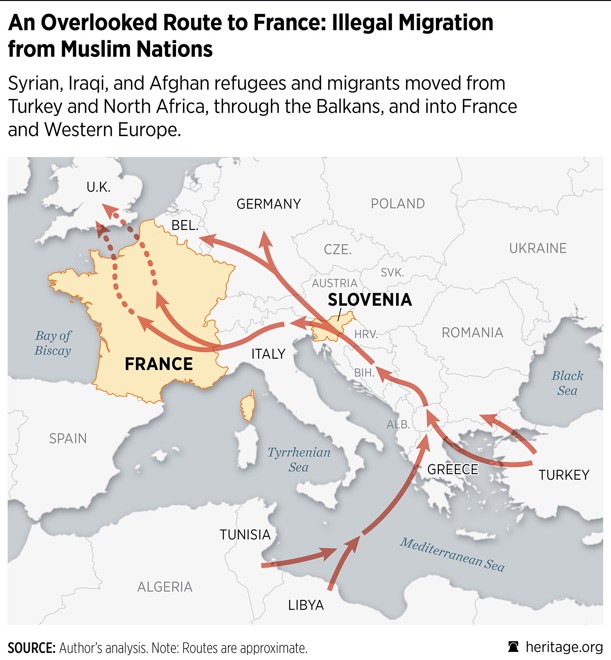
The ongoing riots in France have once again brought the world’s attention to large enclaves of Muslim immigrants in and around the country’s overcrowded housing projects. But foreign observers may be surprised to learn how many of the most recent arrivals came in through the tiny Balkan nation of Slovenia, which enabled a mass migration in 2022-2024. The dynamics of how and why this happened in Europe are well worth our attention in America because, mutatis mutandis, they also obtain along our own southern border. Think of Mexico as our Slovenia.
In 2023, I spent four weeks visiting eight of the countries involved in the transit routes to learn why they had come back to life. What I learned has profound implications for American policy. Led by pioneering member state Hungary, the E.U. had erected a solid barrier along its eastern frontier. But then another member state—Slovenia—elected a liberal government with lax enforcement policies. And that single breach in the defenses left interior countries like France vulnerable once again.
Almost three years have passed since I discovered and reported the Slovenia breach in what had been, for the previous seven years, an effective barrier erected by the European Union. The E.U. effectively put an end to Europe’s catastrophic mass migration crisis of 2014-2016, during which both refugees and terrorists were able to travel freely along the so-called “Balkan Route.”

The Slovenia gap, as I’ll call it, helped flood France with at least 466,000 first-time foreign national asylum and refugee claimants from mostly Muslim-majority nations in 2022-23 alone. Many of these were fast-tracked into the public housing communities now at the center of France’s continuous street violence.
The flow of migrants began in mid-2022 with a key Slovenian election and spiked in 2023 before declining in 2024. Much of the traffic moved along the same Balkan routes traveled by some 800,000 to 900,000 mostly Muslim immigrants during the 2014-2016 crisis (during which there were an estimated two million illegal EU border crossings).
The 466,000 migrants who applied for French asylum or refugee status in 2022-3 hailed from places like Afghanistan, Turkey, and Syria, and Tunisia, as well as Muslim-majority nations in North Africa. Of those, authorities detected approximately 244,000 who traveled on routes through the Balkans; untold thousands more are believed to have traveled those same routes undetected. Among those who registered were France-bound immigrants like an Afghan I interviewed in a Bosnian migrant camp who was en route to the Slovenia gap.
“Taliban good!” he told me in pidgin English when I asked his opinion about the ruling terrorist group in his home country.
A Breach in the Defenses
The Balkan routes generally run northwest from Turkey through countries like Greece, Macedonia, Serbia, Bosnia, and Croatia. Migrants know that once tye penetrate into the periphery of the E.U., a borderless inter-nation agreement (the Schengen Zone) enables inspection-free travel to rich and desirable interior countries, like France.
A decade ago, ISIS fed its terrorist operatives into the migrant flows. They went on to kill and wound hundreds of French and Belgian citizens in 2015 and 2016, while dozens of other border-crossing migrants committed small terror attacks throughout Europe. Because of this mayhem, the E.U.’s external countries buttoned up their borders with stout fences and instant-expulsion policies backed by rigorous patrolling.
SEE Bensman’s Europe Reporting in Video and Print: Dispatches From Europe’s New Mass Migration Crisis: What America Can Learn
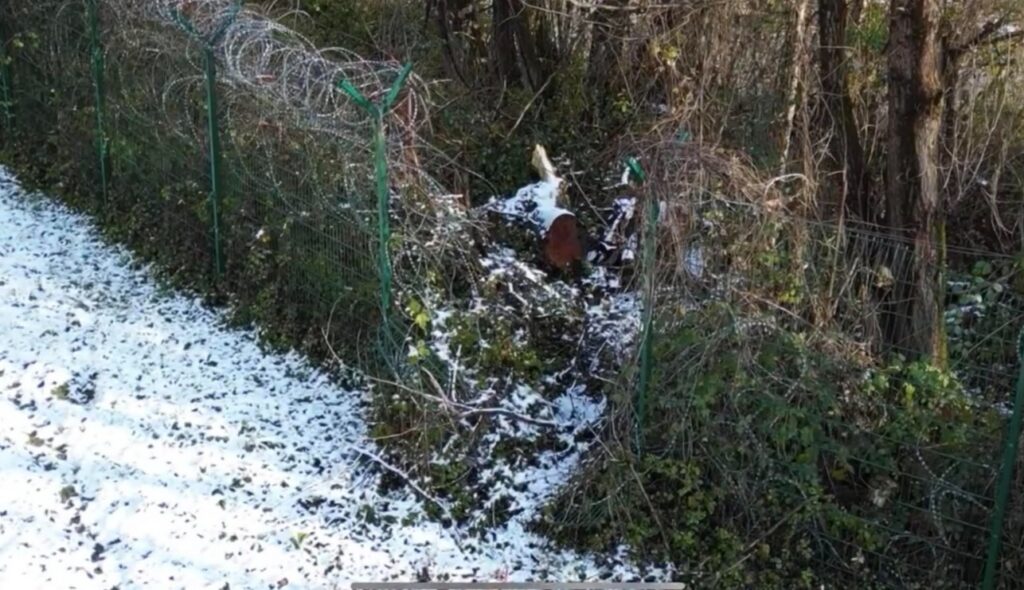
E.U. member Hungary started it off in 2015 with an electrified barbed wire double fence, which immediately choked off the main channel through Croatia and Serbia. When migrants diverted west to avoid it, Austria built another, forcing Slovenia to build a razor-wire fence along the border with Croatia to head off further spillover.
By 2016, the Balkan routes were considered effectively closed. It also helped that the E.U. paid Turkey and some proxy North African nations (and violent militias) billions of Euros to stop and block emigration from their territories.
So how did another mass migration start in 2022 that would flood France with tens of thousands more?
In June 2022, Slovenian voters threw out the center-right Slovenian Democratic Party that had built that fence. They elected the center-left Freedom Movement and installed Prime Minister Robert Golob, who had campaigned to tear down Slovenia’s fence and immediately set about doing so.
News Travels Fast
Word spread that a Slovenia gap in the Balkan Routes had just opened, so migrants came pouring through it. I toured the forlorn remnants of Slovenia’s fence, observing broken-down sections lying where they had been pushed down. Anyone could walk through at will. I never saw a single police officer as I crossed back and forth repeatedly on foot and by car.
Smugglers and self-directed immigrants (including many from Latin America) quickly figured out they could fly without visas into Serbia for a time, or trek on their own up from Greece and into Bosnia for the onward journey through a narrow sliver of Croatian territory to Slovenia. And there they were, inside the E.U. with no opposition, free to travel to France.
E.U. governments pleaded with Croatia to police the territory. But with no wall and a porous border, Croatia was effectively unable to oblige. Immigrants on the Bosnia side told me they planned to push for the Slovenia gap and go on to France.
On the U.N.’s Camp Lipa in northwest Bosnia, for instance, nine young men from Morocco and Algeria were hardly worried about Croatian police catching them as they prepared for the short trek across Croatia to the Slovenia border.
“No problem!!!” almost everyone shouted, laughing as they turned and disappeared into the dark forest, chanting, “Inshallah! Inshallah!”—If God wills it.
Earlier this year, Slovenians elected a conservative government that plans to rebuild the fence. But that’s too late for France.
American Slovenias
Of course, though it was the liberal Slovene government that opened the side door into the E.U., it was government policies in destination countries that lured them through. France, the U.K. and other countries in Europe have clung to policies and processes that prevent quick deportations and, at the same time, provision the arrivals with public welfare. These are powerful lures.
In 2023, immigrants told me they knew France and other destination countries wouldn’t—or couldn’t—deport them. One France-bound Algerian I encountered in northwest Bosnia answered this way when I asked how important the low probability of deportation was to him:
“It’s 90 percent important,” he immediately responded. “If you do all the trip and they catch you and deport you, it’s very, very difficult. This point is very important.”
There’s a lesson for Americans in this practically unknown aspect of French politics: the United States can easily become like France if voters elect liberal politicians who favor lenient immigration policies.
Not just that, though. To avoid becoming France, U.S. policies must include making sure that Mexico and the transit countries of Central America never become the Slovenia I saw a few years ago.
Leave a Reply