Heritage Foundation Backgrounder By Todd Bensman, October 8, 2026
Summary
Before the U.S.–Iran war began in June 2025, the U.S. diplomatic and intelligence communities may have correctly viewed the Iran–Nicaragua relationship as a lower threat to U.S. citizens and interests than Iranian ties elsewhere in Latin America. That judgment merits urgent reconsideration, given the ongoing war between the United States and Iran, Iran’s new national policy to retaliate from all over the world, and Nicaragua’s elevated strategic importance to Iran as one of the more permissive forward operating bases in Latin America since 2025. The U.S. government is obliged to build a new threat picture that illuminates the Nicaragua blind spot and assesses the extent to which Iran and its proxies may have retreated to it from other, newly anti-Iran Latin American governments.
Key Takeaways
— The United States has launched diplomatic pressure campaigns on every Latin American country that maintains diplomatic ties with Iran—except Nicaragua.
— The U.S. campaign against Iran and its proxies in Latin America must include the communist regime of Daniel Ortega and his nearly two-decade relationship with Iran.
— The U.S. should use its considerable leverage to induce Ortega to end his Iran ties and reverse the consolidation of power of his corrupt, anti-American regime.
ollowing U.S.–Israeli airstrikes on Iran’s nuclear weapons project in the June 2025 “12-Day War,” U.S. intelligence agencies warned the American public that risk of retaliation against the United States would substantially increase “if Iranian leadership issued a religious ruling calling for retaliatory violence against targets in the Homeland.”1
That ruling has come to pass amid this year’s renewed hostilities, obliging the U.S. intelligence and homeland defense establishments to devise preemptive measures to protect U.S. citizens, business interests, and perhaps close allies like Israel.
On July 9, Iran’s Supreme Leader Ayatollah Mojtaba Khamenei unveiled a top national policy priority during the Tehran funeral of his father, killed in the first renewed U.S.–Israeli airstrikes on February 28, 2026: Every instrument of Iranian state power, he declared, now serves a sacred religious duty to exact “blood vengeance” on the United States and its leaders.2
Millions attending the funeral understood Khamenei had just invoked the “Ya Latharat al-Hussein” religious vengeance doctrine as regime supporters mourned under a sea of highly symbolic red flags—reflecting the doctrine’s obligation to avenge assassinated Shiite leaders.3
Iran’s state councils, influential regional government bodies that carry out religious policies, declared a “divine mission” and “strategic religious obligation” to attack.4
The regime’s Friday Prayer Policy Council has recast its weekly nationwide prayer services as “Fridays of blood vengeance and revenge” to go on until the required revenge is exacted at clerical standards.5
U.S. homeland security and its Intelligence Community agencies are now obliged to contemplate which nations Khamenei had in mind when he promised that “[s]oon, individuals among the freedom-seekers across the world will each carry out part of this divine mission.”6
In updating their defense posture under President Donald Trump to detect terror plots in the Western Hemisphere, the State Department and intelligence agencies have launched diplomatic pressure campaigns on every Latin American country that maintains diplomatic ties with Iran.7
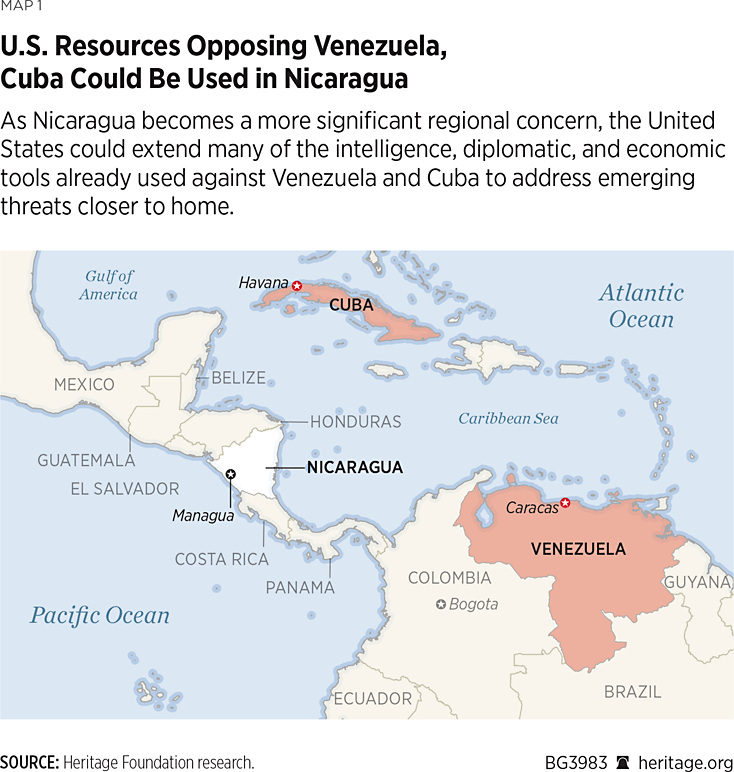
Prior to 2025, Iran had established significant diplomatic and trade relations with and presences in Argentina, Bolivia, Brazil, Cuba, Nicaragua, and Venezuela. It also established relations and consulate offices to lesser degrees with Brazil, Chile, Colombia, Costa Rica, Ecuador, El Salvador, Guatemala, Honduras, Mexico, Panama, Paraguay, Peru, and Uruguay. The United States is pressuring these countries to end their relationships with Iran, and also to help the United States to hunt down associates of Iran’s proxy Hezbollah—which has a strong presence in Latin America—as well as members of the Islamic Revolutionary Guard Corps (IRGC) and the Quds Force, all three of which the United States has declared Foreign Terrorist Organizations. There is one exception: The United States is putting no known pressure on Nicaragua.
This Backgrounder argues that the U.S. campaign against Iran and its proxies in Latin America must encompass the communist regime of President Daniel Ortega and his nearly two-decade relationship with Iran. Iran and Nicaragua’s Ortega established diplomatic relations and traded embassy openings in 2007.
Leave a Reply